
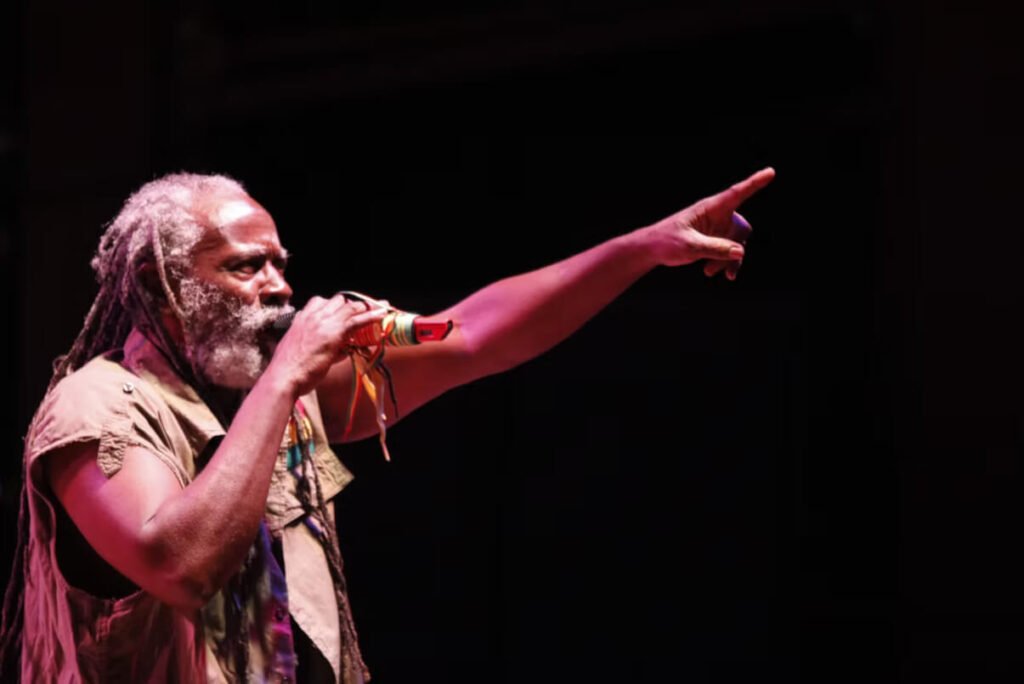
Few artists in reggae carry history as deeply, and as consistently, as Burning Spear. Born Winston Rodney in St. Ann’s Bay, Jamaica, in 1945 or 1948*, his music soundtracked the roots reggae era and helped define it.
*There is still notable disagreement in reputable sources between 1945 and 1948 as Burning Spear’s birth year.
From St. Ann’s Bay to Studio One
Rodney grew up in the same parish as Bob Marley, and it was Marley who encouraged him to head to Kingston and knock on the doors of Studio One, Jamaica’s most important recording hub. As Burning Spear recalls on his official website:
“The way the whole thing came about is that I found myself moving along up in the hills of St. Ann’s and I ran into Bob at the same time. And Bob was going to his farm. The man was moving with a donkey and some buckets and a fork, and cutlass and plants. We just reason man-to-man and I-man say wherein I would like to get involved in the music business. And Bob say, ‘All right, just check Studio One.'”
That advice changed everything. In 1969, producer Coxsone Dodd recorded Rodney’s first single, “Door Peeper.” And it was there that Spear recorded his first two classic albums, Burning Spear and Rocking Time.

The Origin of the Name Burning Spear
Winston Rodney began his musical career in a vocal group called “Burning Spear”, initially a duo with Rupert Willington, then-turned trio with Delroy Hinds.
In the mid-1970s, Rodney became a solo artist and kept using the name Burning Spear.
He had chosen the name Burning Spear because it was a name loaded with meaning. It was inspired by Jomo Kenyatta, the Kenyan freedom fighter. “Jomo” is often translated from Kikuyu as “Burning Spear”. From day one, history and resistance were baked into Winston Rodney’s music.
In an interview by Jason Gross at Perfect Sound Forever, Burning Spear explained how he first picked up the stage name:
“The name is coming from Kenya. Jomo Kenyatta – it was the name they called him, Burning Spear. He was the first president of the Republic. Before I even sing the first song, I was looking for a name. I can remember that this elderly person told me this about Jomo, but I didn’t know anything about him to be honest. This person was thinking that for the kind of melody and lyrics that I was presenting, that would be an appropriate name. So that’s how it came about, Burning Spear.”

Early recordings and the birth of a sound
Initially a vocal group, as mentioned before, Burning Spear released a series of singles at Studio One, including the Jamaican hit “Joe Frazier (He Prayed)”. Albums like Studio One Presents Burning Spear (1973) and Rocking Time (1974) already showed the core elements of Spear’s style: chant-like vocals, spiritual intensity, themes of Africa, repatriation, and Black liberation.
The arrangements were classic Studio One, but the message was unmistakably militant and Rastafarian.
Marcus Garvey: a roots reggae milestone
In 1975, Rodney left Studio One and teamed up with producer Jack Ruby. The result was Marcus Garvey, one of the most important albums in reggae history — and often cited as the definitive dread roots record.
The album was recorded at Randy’s Studio 17 and mixed at Joe Gibbs Studio. The horn arrangements (by the Black Disciples band) were revolutionary because they were mixed with a “lethargic,” spaced-out timing that gave Spear’s chanting room to breathe. The sound was heavier, deeper, and more hypnotic.
Island Records picked up the album for international release, helping bring Burning Spear to a global audience — even if Rodney strongly disagreed with their remixes because the label famously sped up the tracks and brightened the mix to make them more “palatable” for rock audiences. This disagreement over the Island remix led to the release of Garvey’s Ghost, a dub companion that remains a staple for vinyl collectors seeking the raw, ‘undubbed’ weight of the original sessions.
Total independence and classic albums
Determined to stay in control, Rodney began producing himself and releasing music on his own labels. Albums like Man in the Hills (1976), Dry & Heavy (1977) and Social Living (1978) cemented his reputation as reggae’s leading historian and spiritual voice. His lyrics were lessons, sermons, and calls to awareness.

Live power and international recognition
Burning Spear became a fearsome live performer, touring the UK and the US and appearing regularly at Reggae Sunsplash. His appearance in the film Rockers (1979), performing “Jah No Dead” a cappella, remains iconic.
Throughout the 1980s and 1990s, he continued releasing albums while staying rooted in Rastafarian philosophy — even as reggae trends shifted around him.
After a long “retirement” that started around 2016, Burning Spear made a massive return to the stage in 2022 and released a new studio album, No Destroyer, in 2023.
Grammy recognition and late-career strength
After multiple nominations, Burning Spear finally won a Grammy Award in 2000 for Calling Rastafari — a deep, reflective album that proved his message had lost none of its urgency.
Winston Rodney was awarded the Order of Distinction in the rank of Officer on 15 October 2007, a very important honour in Jamaica.
In the following years, he continued releasing strong albums like Freeman and Our Music on his own Burning Music, remaining fully independent.
Burning Spear: Frequently Asked Questions (FAQ)
The name was inspired by Jomo Kenyatta, the first President of Kenya. It is believed that Jomo means “burning spear” in Kikuyu, symbolizing strength, leadership, and courage. Winston Rodney originally used it as the name for his vocal trio before it eventually became his solo stage name.
Yes. Although he announced his retirement from touring in 2016, he returned to the stage in 2022 for a series of high-profile “Fan Appreciation” shows and has continued to perform select dates through 2025 and 2026.
He has won two Grammy Awards for Best Reggae Album: one in 2000 for Calling Rastafari and another in 2009 for Jah Is Real. He has been nominated 13 times for the Grammy Award for Best Reggae Album.
Sources:
Official Burning Spear Biography at burningspearwebsite.com
Biography by Jo-Ann Greene allmusic.com
Biography at udiscovermusic.com
Interview at Perfect Sound Forever
Images from burningspearwebsite.com and reggaeville.com